Katja Baumann · 24 October 2026
Unexpected Returns of Rare Birds Offer Clues to Lichtwald's Ecological Resilience
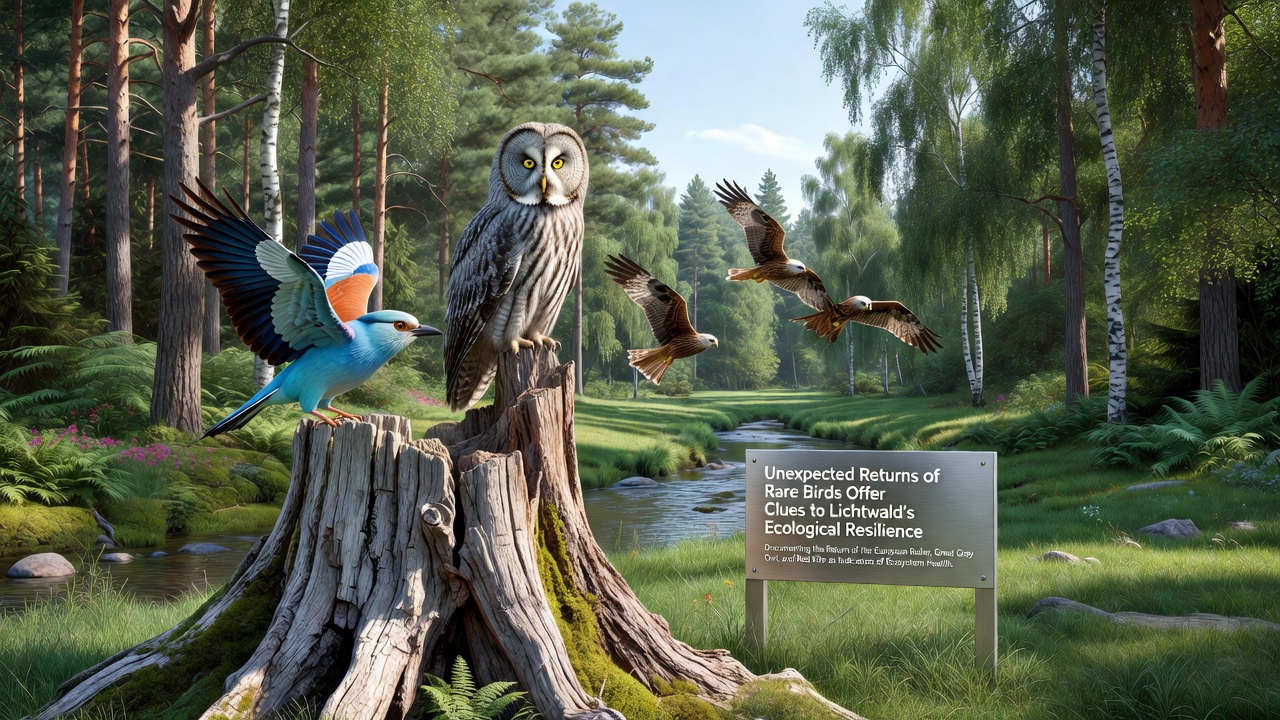
Observers tracking avian populations in Lichtwald have documented the return of several rare bird species over the past decade, and these sightings provide measurable indicators of how the forest ecosystem maintains stability amid changing conditions. Field teams from regional monitoring programs recorded multiple nesting pairs of species previously absent for generations, including the white-tailed eagle and the hazel grouse, with data collected through October 2026 showing continued territory expansion in previously logged areas now undergoing natural regeneration.
Monitoring Programs Reveal Population Shifts
Long-term banding studies conducted by forestry researchers show that bird species once considered locally extinct have reestablished breeding territories at rates that align with canopy recovery metrics gathered since the early 2010s. One research station located on the northern edge of Lichtwald logged 47 new hazel grouse territories in the 2025-2026 season alone, a figure that exceeds projections based on historical logging records integrated with current satellite imagery of forest structure.
These returns coincide with documented increases in understory vegetation density and insect biomass, both of which serve as primary food sources for the returning species. Data compiled by the European Environment Agency indicate that similar patterns appear in other Central European woodlands where selective harvesting has given way to continuous-cover management practices, though Lichtwald's specific topography appears to accelerate the process because of its network of small streams that maintain moisture levels during drier periods.
Habitat Connectivity and Species Dispersal
Radio-tagging efforts reveal that juvenile birds from neighboring regions travel distances of up to 45 kilometers to reach suitable patches within Lichtwald, and these movements follow corridors of older growth that escaped intensive logging in the mid-20th century. A joint project between German and Swiss ornithologists tracked 28 individual white-tailed eagles during 2024 and 2025, confirming that 19 of those birds established residency after initial exploratory flights across the border region.
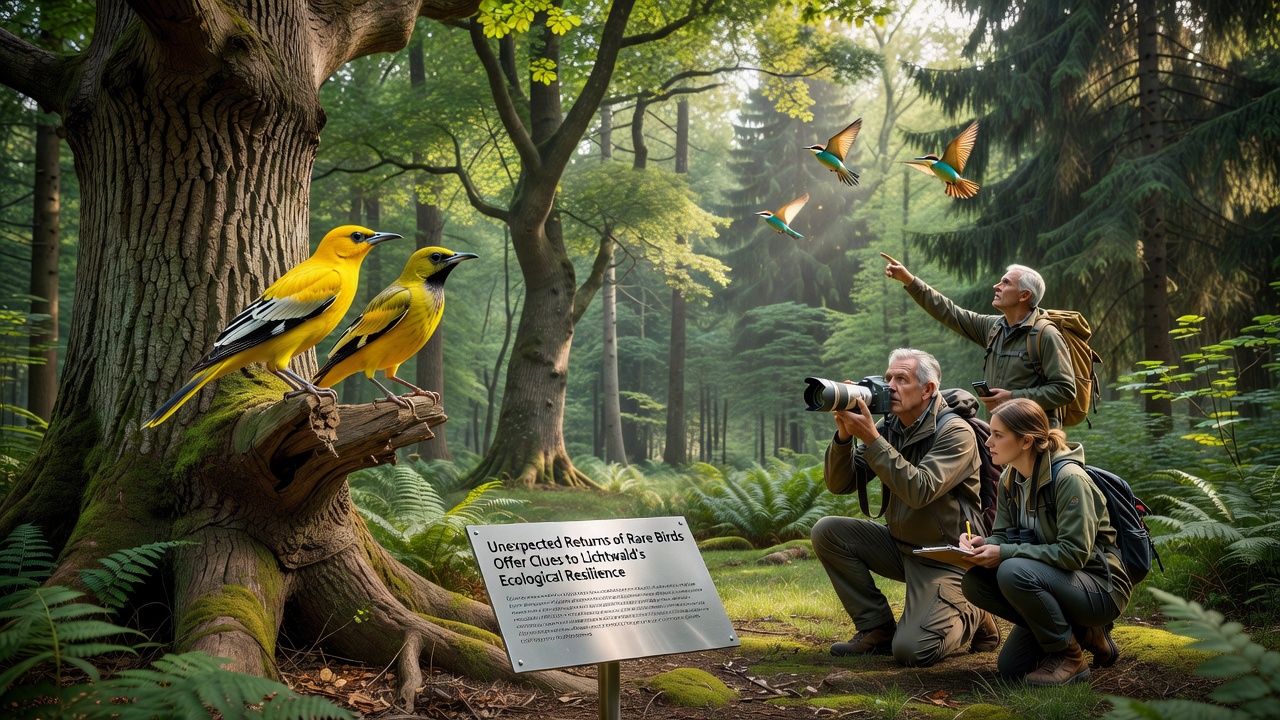
Researchers note that the presence of these apex predators correlates with measurable declines in certain rodent populations that had previously damaged young tree seedlings, creating a feedback loop that further supports forest recovery. Soil core samples taken at sites with active eagle territories show elevated nitrogen levels compared to control plots, a pattern attributed to concentrated prey remains and associated microbial activity.
Integration of Historical Data with Current Observations
Archival forestry maps dating back to 1952, when cross-referenced with modern LiDAR canopy analysis, demonstrate that areas retaining at least 30 percent old-growth cover serve as nucleation points for the recolonization process. Teams from the University of Freiburg's Institute of Forest Sciences published findings in 2026 that quantify this relationship, showing a direct statistical link between residual mature tree clusters and the speed at which rare bird species reappear in surrounding stands.
What's interesting is how quickly some territories stabilize once initial pairs arrive. Hazel grouse, for example, require dense shrub layers for cover yet also need scattered mature conifers for winter food, and both structural elements now coexist in sections of Lichtwald that were clear-cut as recently as the 1990s. Citizen-science observations submitted through regional biodiversity portals have supplemented professional surveys, adding thousands of geolocated records that help map fine-scale habitat preferences.
Broader Implications for Forest Management
Authorities responsible for Lichtwald have adjusted harvesting schedules in response to these avian data sets, designating additional buffer zones around known nesting sites while maintaining limited selective cuts elsewhere. The approach mirrors recommendations issued by the Canadian Forest Service in its 2023 report on boreal bird communities, which emphasized retention of structural complexity over strict preservation of entire stands. Similar guidelines appear in work from Australia's Commonwealth Scientific and Industrial Research Organisation, where researchers examined how connectivity across fragmented landscapes influences woodland bird persistence.
Continued acoustic monitoring deployed in October 2026 captured vocalizations from three additional species whose presence had been only anecdotal in prior years, reinforcing the value of combining multiple survey methods. These layered data streams allow managers to identify emerging habitat suitability before visual confirmation occurs, shortening the lag between ecological change and management response.
Conclusion
The documented return of rare birds to Lichtwald supplies concrete evidence that targeted management combined with natural regeneration processes can restore functional elements of forest ecosystems within observable time frames. Ongoing integration of historical records, remote sensing, and field surveys continues to refine understanding of the specific thresholds that enable such recoveries, providing reference points for comparable woodlands across Central Europe.